Tag: Women Empowerment

  • From Stitching Threads to Weaving Success     

    From Stitching Threads to Weaving Success     

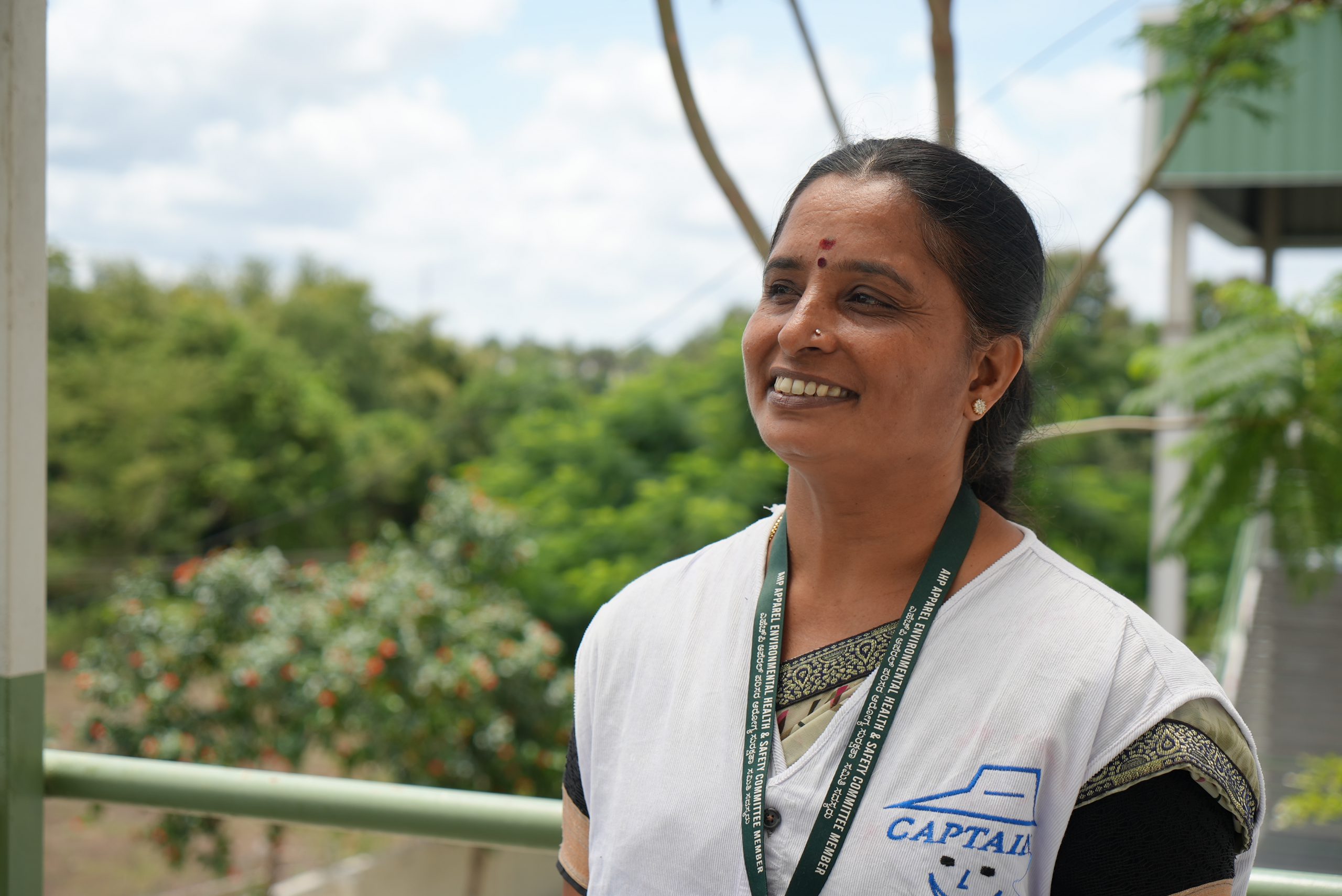
    Rathnamma’s incredible story of training under almost all of Shahi’s programs to leading a line of her own and striving for a better workplace.

    “There was a school in my village, Chiknallie, opposite my house. For almost seven years, I served as a teacher there,” Rathnamma said; her eyes sparkled, and a wide smile embraced her face. 

    Rathnamma, a resilient and determined individual hailing from Pandavapura, Mysore, has a story that embodies perseverance and adaptability within the backdrop of a close-knit, rural community. She has remained a valued member at Shahi in Mysore for four years.

    The sparkle turned into a determined fire when asked why she moved to Srirangapatna. She has a singular goal,

    “So that my children can have a good education. I am passionate about ensuring my kids receive a good education.” 

    She joined Shahi as a tailor and was enrolled in the Gap Inc. P.A.C.E. Program. 

    “When I was first introduced to the Gap Inc. P.A.C.E program, a group of us humorously mistook it as the FACE program. I was puzzled, wondering what they would teach us about faces and related topics,” she chuckled. Designed to support career and personal life development, the program unveiled new perspectives and insights.

    “It helped me see things from a different perspective and highlighted areas where improvements could be made. I also learned how to approach my responsibilities at work and within my family.” Rathnamma’s growth, adaptability, and pride are evident.

    In 2021, Rathnamma became Captain in the cutting department. She proudly says,

    “It was recognized that I possessed leadership qualities and the ability to manage and lead a group of people effectively.”

    But, her desire to learn led her to sign up for STITCH. A takeaway for Rathnamma was how to motivate her colleagues on a fast-paced factory floor. Her approach is “grounded and empathetic.”

    “Before they begin working on the machine, I make it a point to call them in advance,” she explains. Her proactive guidance ensures smooth transitions for her team from one style to another.

    Her dedication to her work and community is evident in her election as a committee member. Currently, she serves as an EHS committee member, focusing on the well-being and safety of her fellow workers.

    “If I could speak to my younger self, I would convey a message of resilience and pride. I would tell my younger self that she once may have felt confined like a frog in a well but broke free of those limitations.”

    Rathnamma pursued her dreams, acquired new skills through hard work, and emerged as a leader, all while remaining deeply committed to her family and community.
  • Sharing the Legacy of Empowering Women: The G20 EMPOWER Best Practices Playbook

    Sharing the Legacy of Empowering Women: The G20 EMPOWER Best Practices Playbook

    Our legacy, rooted in empowering women, has helped Shahi make significant strides in promoting gender equality and economic empowerment. Anant Ahuja, Head of Organizational Development at Shahi, joined the G20 Empower Alliance as an Advocate, reinforcing the company’s commitment to women’s advancement and carrying forward Shahi’s legacy of building financial independence, providing access to health awareness, and enhancing soft skills for women.

    The G20 EMPOWER initiative, short for the G20 Alliance for the Empowerment and Progression of Women’s Economic Representation, is a global movement with a clear vision—to be the most inclusive and action-driven alliance among businesses and governments, accelerating women’s leadership and empowerment across G20 countries. It’s an ambitious endeavor is dedicated to advancing women’s roles in the private sector and achieving gender equality.

    G20 Empower’s Best Practices Playbook

    One of the outcomes of the G20 Empower initiative is the Best Practices Playbook. This valuable resource compiles best practices from organizations across G20 countries and invited nations. It focuses on four key areas:

    • Measuring to Improve
    • Building and Nourishing an Efficient and Sustainable Women Talent Pipeline
    • Enabling Women to Lead the Future
    • Supporting Women Entrepreneurs & Leaders at the Local Level

    This year, a new focus area, ‘Supporting Women Entrepreneurs & Leaders at the Local Level,’ has been added, strengthening the commitment of both the private and public sectors to women’s advancement.

    The Playbook features the best practices of 151 organizations across 19 G20 countries and invited nations. It’s a testament to the collective efforts of these organizations to advance women’s leadership and empowerment.

    Leading the way: Shahi’s Best Practices

    Shahi has heavily invested in studying the impact women’s empowerment can have on businesses.

    Our collaboration with GAP Inc, piloted the P.A.C.E. (Personal Advancement & Career Enhancement) training program in 2007. This program offers comprehensive curriculum-based training, focusing on managerial, interpersonal, organizational, and practical skills. It’s designed to empower women not just in their careers but in their lives.

    The program extends its impact beyond the workplace, sensitizing supervisors, factory staff, and even family members of garment workers. It creates a supportive environment that empowers women to apply their newly acquired skills, helping them break down the barriers to personal and professional growth.

    Our company has established over 80 training centers in collaboration with public-private partnerships, creating employment opportunities and serving as a vital stepping stone for economic progress. These centers offer comprehensive training, including the GAP Inc. P.A.C.E. program, as a standard part of their curriculum. Shahi has already trained 74,000 female workers through the GAP Inc P.A.C.E. program, with a goal to benefit 90,000 workers by 2024.

    Through relentless research and innovation, Shahi has introduced transformative training initiatives like the STITCH program tailored for supervisors. This soft skills training program enhances their capabilities in self-reflection, making them more effective leaders and team members.

    Advocating for Empowerment

    Earlier this year, Anant Ahuja, Head of Organizational Development at Shahi, joined the G20 Empower Alliance as an Advocate. Reinforcing the company’s commitment to women’s advancement and carrying forward Shahi’s legacy of building financial independence, providing access to health awareness, and enhancing soft skills for women.

    “Empowering women is essential to the goal of gender equality and equity,” says Anant Ahuja. He reflects on Shahi’s history, founded by his grandmother, Sarla Ahuja, with a vision to provide independent income to women.

    Through the G20 Empower Alliance, Shahi has become part of a global community of like-minded leaders dedicated to the advancement and empowerment of women. Anant Ahuja’s words resonate: “We hope to make the experience of scaling new heights for women even better, more satisfying, and rewarding.”

  • IOM-UN Migration and Shahi Exports Join Hands to Facilitate Safe Migration through Migrant Support Centre

    IOM-UN Migration and Shahi Exports Join Hands to Facilitate Safe Migration through Migrant Support Centre

    New Delhi, 15 December 2022: Economic Survey reported that between 2001-2011, the Inter-state labor migration in India averaged between 5 to 6 million people a year which constitutes 17%-29% of the labor force. Migration and related activities undertaken by migrant workers are estimated to contribute 10 percent of India’s GDP. These activities have positive externalities in terms of benefits to their families, native communities, and destination states/communities. Some of their contributions can be seen in the labor-intensive garment and textile sector. Composed of many small, medium, and large-sized enterprises, this sector has grown exponentially, from domestic production to engagement in export-oriented global supply chains, which has fuelled employment opportunities for varied skill sets across the country.

    Nevertheless, internal migration in India is rife with challenges. Much of these can be addressed at the origination itself— that is, the transition period when migrants move from their hometowns all the way until they settle in a new place.

    The International Organization for Migration (IOM), on 30th September 2022, signed an MoU with Shahi Exports to support and assist migrant workers through the institutional framework of a Migrant Support Centre (MSC). Shahi Exports, India’s largest apparel manufacturer, has been running the MSC for migrants working in various industries across Bengaluru since 2021. Currently, it serves nearly 4,000 migrants. Under this partnership, IOM will provide technical and advisory support to strengthen and operationalize the Shahi-run MSC in Bengaluru. IOM will assist Good Business Lab (GBL) –  a not-for-profit labor innovation organization, to understand the issues faced by interstate and intrastate migrant workers in an urban setting and empower migrant workers and improve all aspects of their welfare–  working conditions, access to legal entitlements, social security, health, education, and vocational skills. GBL came on board as the project’s design partner, conducting visits to existing MSCs to understand the provisions of specific services and if there exist any disconnects between migrant experiences and support offered by centers. 

    IOM’s Head of Office, Sanjay Awasthi, observed that such a collaboration would leverage the strengths of multiple stakeholders across the supply chain to achieve the envisioned benefits not only for the migrant workers and their employers but towards the social and economic development of migrants’ source and destination states, and ultimately India as a whole. To mitigate these risks and to intensify the socio-economic benefits of internal migration, it is imperative that supply chain partners play a role in ensuring the welfare of migrant workers. 

    Migrant workers are also particularly vulnerable to disasters and crises, as evidenced by the impact of the COVID-19 pandemic. 

    Shahi Export’s MSC evolved out of COVID-19 relief efforts conducted by Shahi Exports, such as facilitating vaccination drives, free phone consultancy with ophthalmologists, information services on preventative measures, availability of transport, and providing food rations to migrant workers. 

    Screenshot 2022-12-17 at 10.31.06 AM
    Anant Ahuja, Head of Organizational Development at Shahi Exports

    “The MSC provided shelter, utility support, medical aid, financial, legal literacy, and toll-free redressal numbers to resolve issues migrants face in the garment industry and other sectors. We gained valuable feedback from the beneficiaries of the center to help us, and the learnings from our first effort make us confident to scale MSC up to reach 10,000 migrants by 2025. Our multi-stakeholder partnership with IOM will leverage their global perspective and combine it with the knowledge of on-ground partners, including state government wings like Odisha Rural Development And Marketing Society (ORMAS), to achieve a model that can give migrants the support they need in a new city or town.”

    Amit Chowdhury, National Officer, IOM India

    IOM has provided technical support for the establishment and functioning of several such centers for migrants throughout the world.“These centers (also known as Migrant Resource Centres) serve as a source of information and support to migrants at either their destination or source locations and further promote greater social inclusion and interaction. The partnership between IOM and Shahi would continue to work with other institutionalized stakeholders (governmental and non-governmental) directly or indirectly engaged in the facilitation of migration-related issues to ensure safe and secure mobility of migrant workers.”