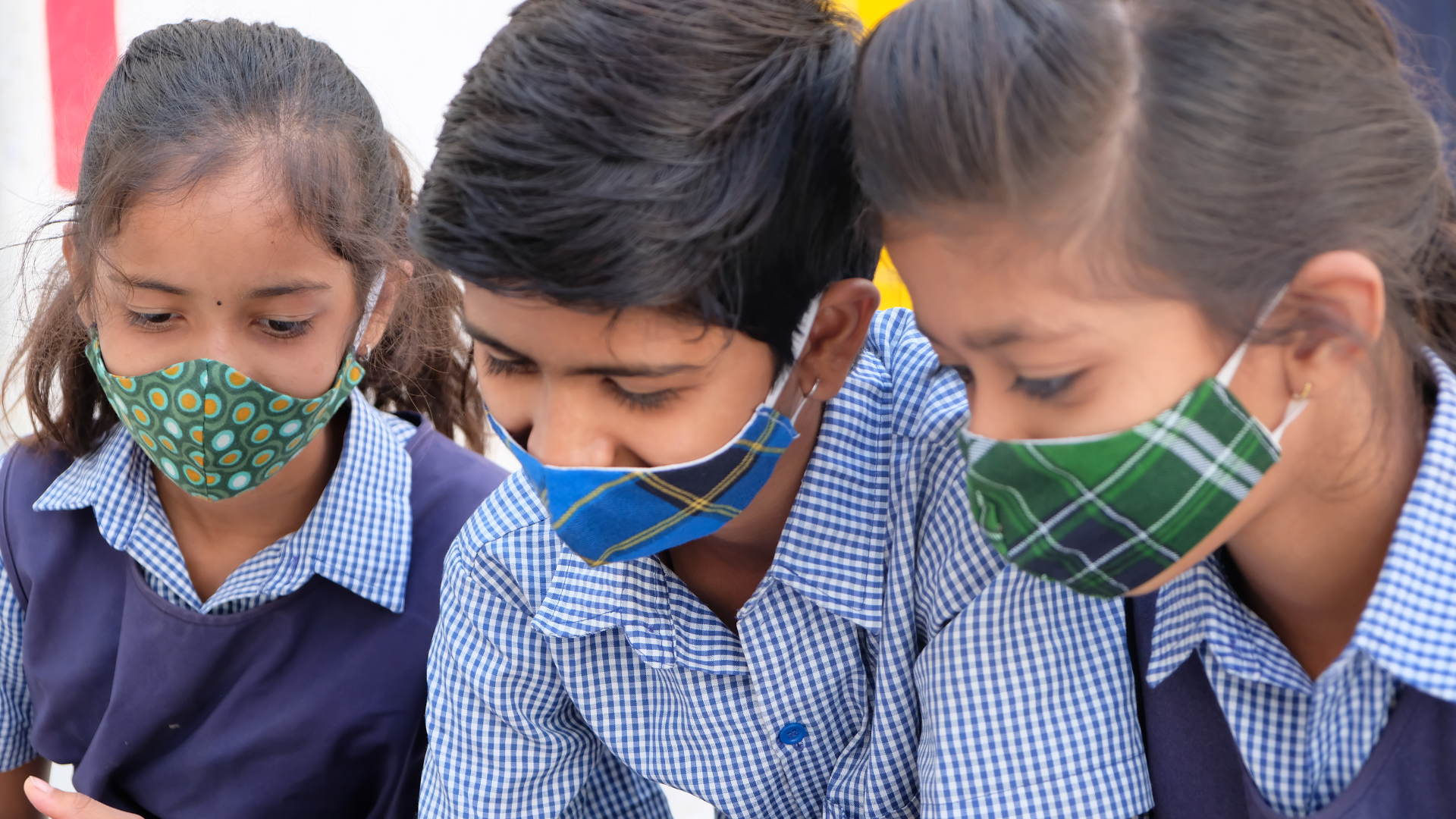
Remember that feeling of staring out the window during a class, your mind a million miles away, sketching fantastical machines or spaceships in the margins of your notebook? Those doodles, fueled by childhood curiosity, held the potential for a future astronaut, engineer, or inventor. But sometimes, the traditional classroom setting might not fully capture that spark. It could be the marks or your mind on a wild goose chase for that formula!
In India’s bustling schools, where millions of young minds hold the potential to revolutionize the future, fostering a love for STEM (Science, Technology, Engineering, and Mathematics) presents unique opportunities.
The Heightened Demand for STEM Skills
STEM skills, in particular, are experiencing a surge in demand across various sectors. Industries across the board, from manufacturing and logistics to finance and marketing, rely heavily on a strong foundation in STEM disciplines. From complex data analysis in finance to intricate calculations in engineering, a strong foundation in STEM concepts is becoming increasingly crucial for success in the modern workplace.
Is India Meeting the Demand?
School education forms the foundation of India’s workforce. 86% of India’s labor force has education up to Class 12 or below. Around 36.3% of boys in the 14-18-year-old age group enroll in STEM streams, with a lower enrollment rate of 28.1% among girls. Most of the young people in this age group enroll in the Arts/Humanities stream, comprising 55.7%. While the exact demand for STEM professionals varies by industry, these statistics suggest a potential shortage. India has a vast young population, but it needs to equip them with the necessary skills to thrive in a technology-driven world.


Why Foundational Years Matter
The early years are a time of immense intellectual growth. Children are naturally curious explorers, eager to understand the world around them. By providing engaging and interactive experiences, we can equip them with critical thinking, problem-solving, and collaboration skills – foundational skills that benefit them not just in science and math classrooms but in every aspect of their lives.
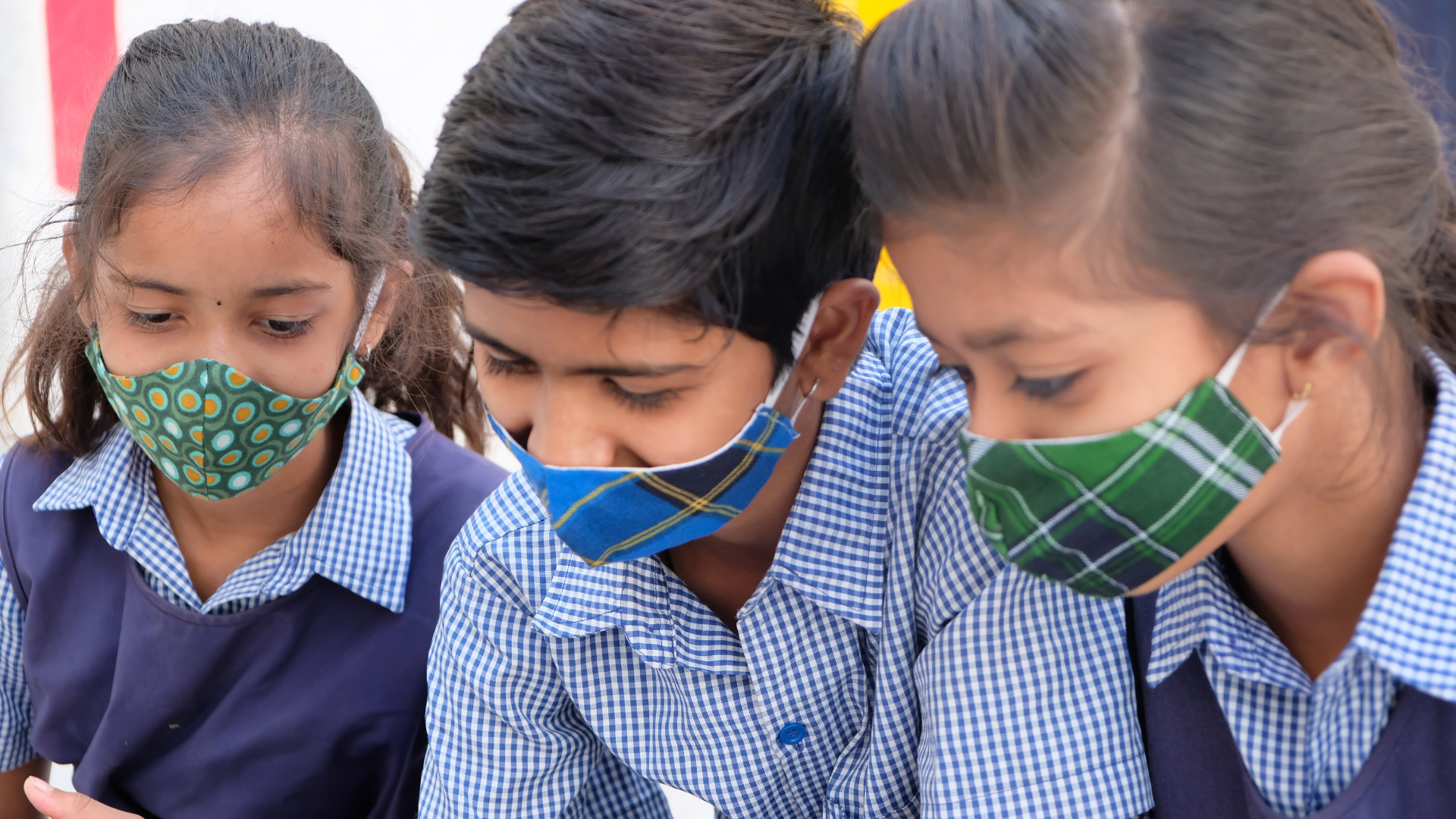
However, the road to a robust STEM education system in India is not without its hurdles. A staggering statistic reveals that one in four schools in rural India lacks basic facilities. Many of these schools miss essential resources, such as laboratories, which are crucial for effective science education. Furthermore, most initiatives in rural areas tend to focus on economic development and agriculture, often sidelining science education. The absence of basic amenities and a focus on other priorities hamper students’ ability to learn effectively and limit their exposure to practical, hands-on learning experiences.
Akshara: Inspiring Young Minds
Akshara: The school development project under Shahi’s Shikshanam Initiative seeks to partner with STEM Learning, a social enterprise to facilitate a unique way of teaching and learning STEM.
At Shahi Exports, Our commitment extends beyond mere business; it’s a shared vision to empower the next generation. We understand the critical role STEM education plays in fostering innovation and building a skilled workforce. The Akshara program is a fantastic initiative that equips young minds with the scientific knowledge and critical thinking skills necessary to thrive in the modern economy.”
– Alagappan R, COO, Knits Processing Division
This innovative program encourages the building of mini science labs in government schools equipped with materials to explore over 80 modules in foundational STEM concepts. Imagine a classroom transformed – a vibrant hub where children can build circuits, conduct experiments, and explore the wonders of science firsthand!
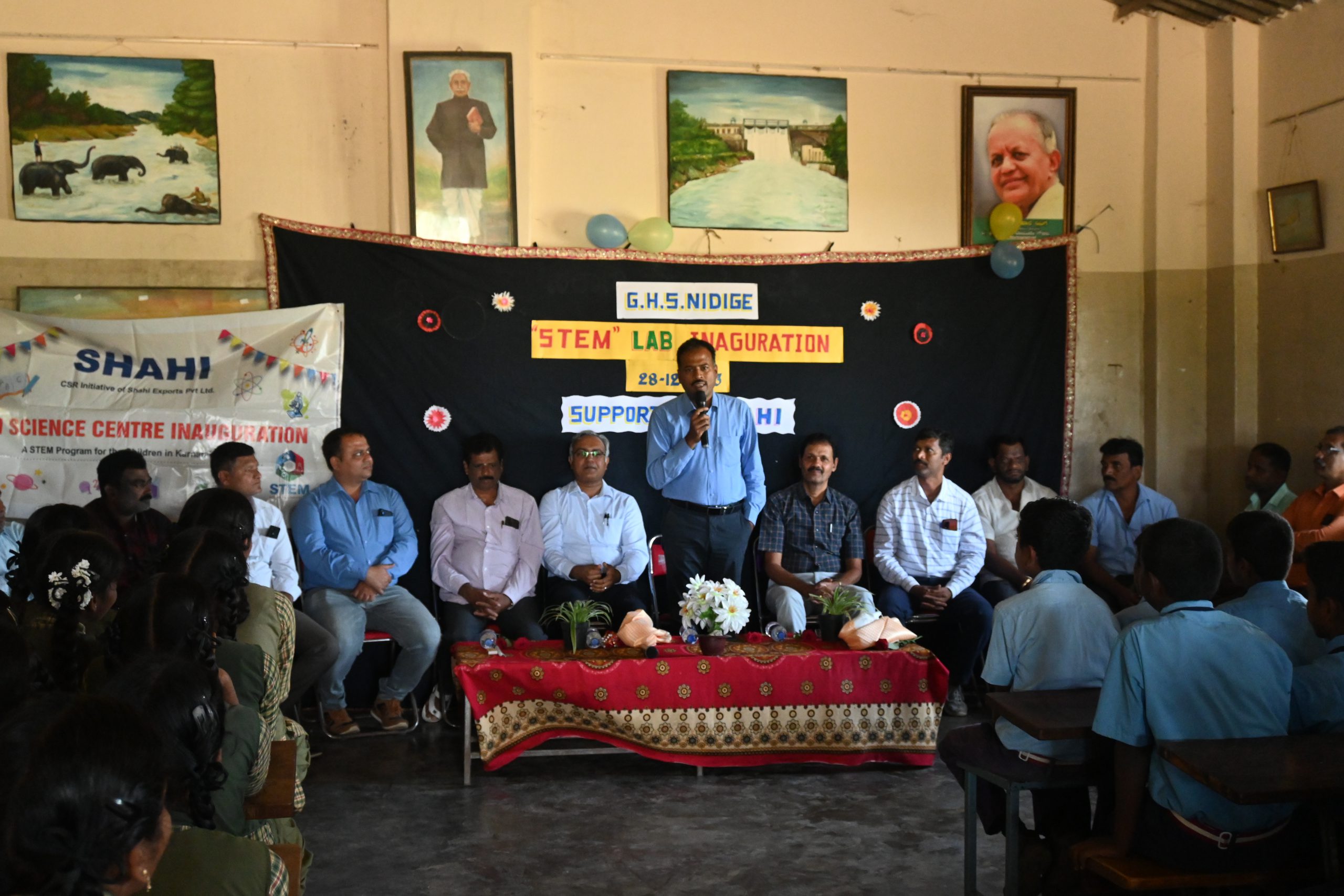
Since 2021, Akshara has provided access to STEM Learning 24 Mini Science Centers to 5300 students across Government schools in rural Karnataka. We aim to reach 6000 students by 2025.
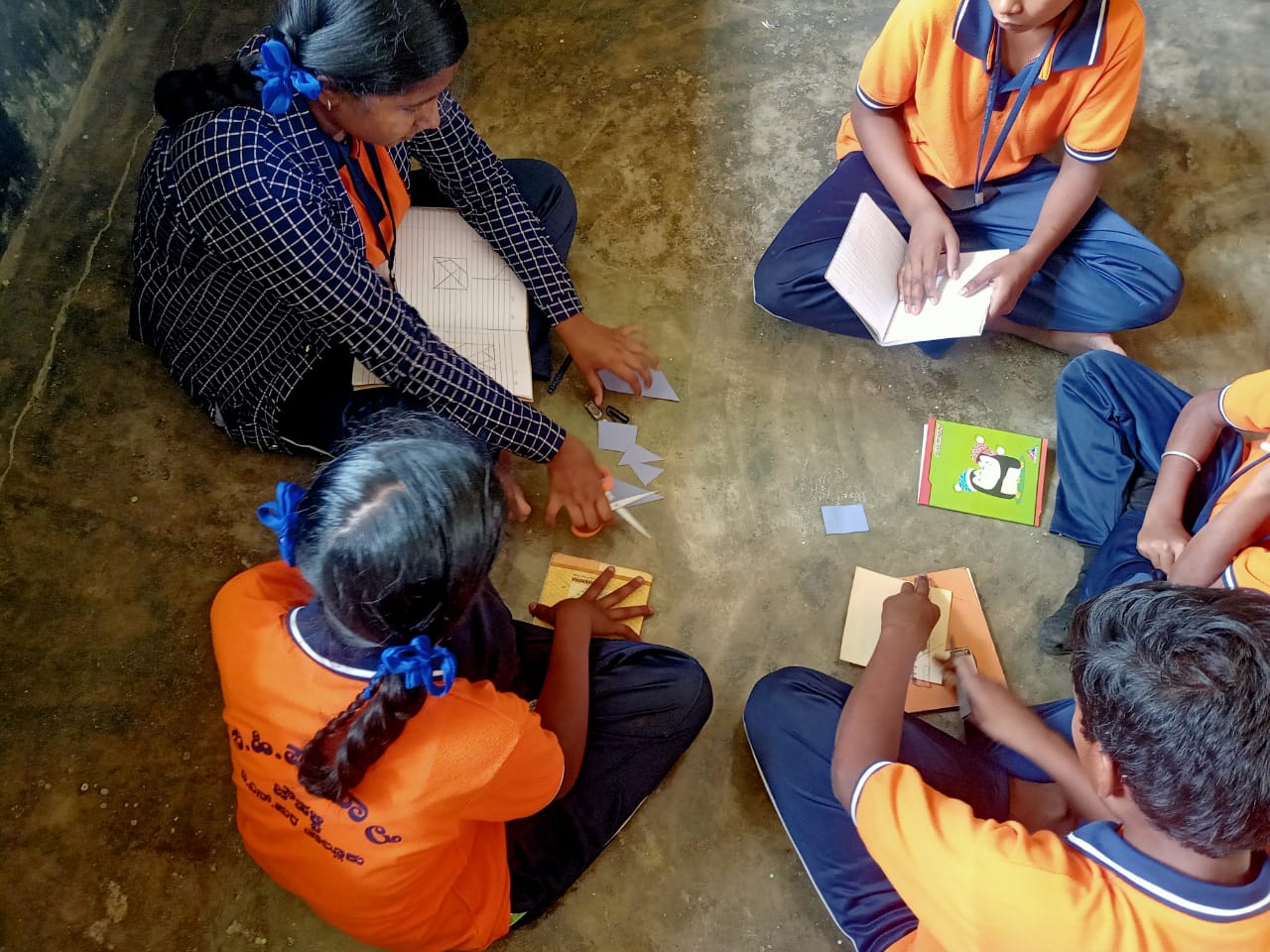
Do-It-Yourself (DIY) projects bring an exciting dimension to STEM learning. It brings concepts to life where students can hold tools in hand and transform simple materials into working models. For example, Tangrams— a Chinese puzzle made from geometric shapes. Students cut colorful sheets into five triangles, a square, and a parallelogram, then combine these pieces to form various shapes. Tangrams are a great way to develop problem-solving skills, spatial reasoning, and creativity. They can also help with hand-eye coordination and visual perception. As students build, test, and iterate, they develop a deep, intuitive understanding of science and math, turning abstract ideas into tangible realities.
Empowering Educators
The Akshara program understands that impactful learning requires more than just resources. That’s why the program goes a step further by providing dedicated support to teachers. Educators receive comprehensive training on how to make the most of the Mini Science Centre models, ensuring they can effectively guide students through engaging activities and experiments. Teachers believe students grasp science and math concepts more easily due to the models and optimized teaching time.
“Explaining concepts like motion and friction is difficult without demonstration. But the Science Center has transformed my classroom! Many biology models, like the Human ear and Human eye, help students understand these structures better. Seeing the excitement in my student’s eyes as they build and experiment with the Mini Science Centre models is truly rewarding.”
Tamanna Roshan, Teacher, Government Higher Primary School, Kanchanahalli.
86% of students reported that complex and difficult topics were explained more easily with the assistance of models, and 91% of students feel the teaching-learning process is more engaging and interactive with the Mini Science Center. *
The Real Impact
This commitment to both resources and teacher training has yielded impressive results. Studies have shown that students participating in similar programs demonstrate improved academic performance in science and math, increased analytical thinking skills, and a higher level of engagement in the classroom. The impact of the Akshara program itself is equally compelling. 87% of students found it easier to express their understanding, and 13% felt more confident applying concepts to real-life scenarios*. DIY activities enabled the students to apply their knowledge and turn these into skills they can explore further.
“The MSC lab makes me happy just by hearing its name. Before the Akshara program, science class felt boring. Now, it’s my favorite subject! I love building things and figuring out how they work. The Mini Science Centre models are so much fun, and help me understand the concepts better. The Day and Night model looked cool and gave me a clear idea of how day and night occur, which I only knew from theory in 5th grade. I love all the models in the school and enjoy spending time in the lab.”
Jayanth J S, Class VII student at Government Higher Primary School, Arekere
A Brighter Future
The impact of such programs can be profound. Consider a young girl, once curious about the world around her, who now lights up with excitement as she builds a tiny solar-powered car. This newfound passion for exploration can pave the way for future careers in science and technology or simply equip her with the critical thinking skills necessary to tackle any challenge life throws her way.
We are excited to explore how to make STEM learning even more engaging and empower the next generation of Indian innovators to take their doodles from the margins of their notebooks to the forefront of the future.
*Endline Survey Conducted by STEM Learning amongst students from 5th-7th Grade in 2023-24.